Euri and I went to Las Vegas for her birthday this year. (Last year it was Palm Springs.) While we were there, we used Uber, taxis, and Waymo, which had only started giving rides in Las Vegas in September. Of the three, Waymo was our favorite option by far. I'm not a gambler, so between overpriced food and storefronts offering purses I couldn't imagine spending that much money on, Waymo was probably the highlight of the trip for me.
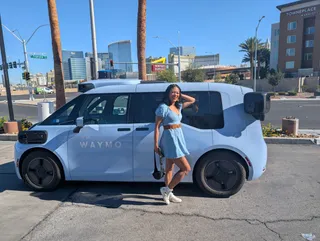
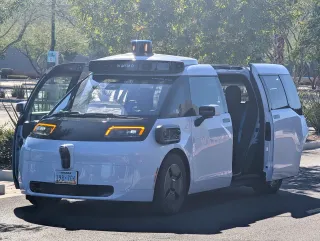
Are Waymos safe?
When I tell people we used Waymo in Vegas, the first question they ask is whether or not we felt safe. When we ordered the first ride, we were feeling that anxiety a bit ourselves as we watched the Waymo drive up and mechanically jerk its wheels a little to get to the pickup spot.
Things started to feel safer once we were in the car. The seats are comfortable, and the cabin is spacious. As it was driving, it was clear that Waymo puts safety first.
There was one point in time where a pedestrian was too close to the edge of the sidewalk and the Waymo slowed down and stopped because it wasn't sure what the pedestrian was going to do.
Another time, the Waymo made a left turn but didn't have quite enough space to make it into the right-hand turn lane to pull into a parking lot. Instead of being aggressive and getting over like a human might have done (or a taxi driver definitely would have done), it went around the block and made a clean, safe turn into the parking lot.
That's just our experience, but Waymo's own numbers back it up. Across more than 270 million driverless miles through June 2026, Waymo reports 82% fewer injury crashes and 95% fewer serious-injury crashes than human drivers in the same cities. That's Waymo grading its own homework, but an independent IIHS study came to a similar conclusion: 81% fewer injury crashes per mile than human drivers.
Sitting in the back seat of the Waymo watching the car drive itself, I found myself drifting back to a childhood memory when my mom was driving us down the freeway and I thought I saw a car without a driver. I'm pretty sure that was just someone with their seat back really far. Here I was, 40+ years later, riding in a driverless car. Times have changed.
How does Waymo compare to Uber and taxis?
Waymo was a highly enjoyable experience. When we placed an order, the Waymo would arrive to pick us up faster than Uber could locate a driver. I think the longest we had to wait for a Waymo to pick us up was four minutes.
We took several Ubers while we were in Vegas, and each time it took at least five minutes for Uber to find a driver to accept our ride. While we were there, we also took taxis a couple of times. In the Waymo, we felt perfectly safe. In taxis, it was clear the driver was racing 15 or 20 miles over the speed limit so they could drop us off and find their next fare.
It was also nice to hop into a car and not have to worry about an awkward conversation, or worse, awkward silence. My wife and I could talk freely without having to worry about being overheard.
Also, we didn't have to tip. Our typical Waymo ride was about 20 minutes and cost about $18. All-included, Waymo was probably 15% cheaper than Uber or taxis, was easier and faster to call, and we felt safer due to the cautious driving habits of our AI overlords.
Could Waymo be the beginning of the end of our current form of capitalism?
Riding around in the Waymo, I started thinking about whether or not I would even need to own a car if Waymo can grow like a cellular network. Today it's in a handful of cities, but picture it everywhere, the way cell coverage is now. Could I ride a Waymo from Los Angeles to New York? Sure, I'd have to get out and change cars every 200 miles or so, but if the next one is already waiting or going to be there within five minutes, that's as easy as stopping for gas.
That's for a long trip. What about for a short trip? My household owns two cars. Most of the time they are both sitting in the driveway collecting dust. For that privilege, AAA estimates the average new car costs $12,863 a year to own and operate, or about $1,072 a month. That's per car. With two of them, we're paying for that privilege twice.
Cars are expensive. How does that cost break down?
Here's where the money goes, based on AAA's 2026 study (which assumes 15,000 miles a year), Experian's car loan data, and Insurify's insurance data:
Car payment: $767 per month for a financed new car and $537 per month for a financed used car, according to Experian.
Car insurance: about $186 per month ($2,237 a year) for full coverage, according to Insurify. Estimates vary a lot depending on who you ask, and some put it closer to $2,900 a year.
Fuel: about $216 per month ($2,595 a year), or 17.3 cents per mile, according to AAA.
Maintenance, repairs and tires: about $146 per month ($1,755 a year), or 11.7 cents per mile, according to AAA.
The biggest cost isn't on that list at all. A new car loses an average of $4,422 a year in value, about $369 a month, according to AAA. Your car payment covers some of that loss, so don't add the payment and depreciation together, but either way it's money you don't get back.
What if I didn't need to own a car?
That got me thinking: what if I didn't need to own a car? If Waymo will pick me up in under five minutes, I could make a trip to the grocery store and back every day of the month. At about $18 a ride, that's roughly $1,080 a month, about what it costs to own one car. For a household like mine with two cars, it's half.
Now let's say a family gives up both cars. I could see people wanting to keep one as a safety blanket, and that's fine. Even dropping one car would save the average household a lot of money, and it would start to slowly eat away at the idea of ownership.
Cars become abundant
Once we convert cars into an abundant, always-available utility, people may stop wanting to own a car. That would break down an attachment to ownership that could spread into other things as AI and robotics start to transition us from a mindset of scarcity into a mindset of abundance.
Owning things, and wanting to buy more things, is a big part of what keeps capitalism afloat. If AI, robotics and other technologies can replace human labor (I already build software with AI every day) and liberate us from the rote work, that would fundamentally shift capitalism, if it doesn't destroy it outright. Waymo could be the tip of the iceberg into a new economic form the world has never seen.
There would be casualties. The people driving taxis and Ubers today would be among the first to lose their jobs. Maybe that means basic income becomes a thing sooner rather than later.
The concept of ownership creates psychological attachments to places other than the present, so if we can break those, we may see a large shift in our outlook on the world. Perhaps we will be able to be more present. Perhaps we can embrace art and leisure and stop worrying about where our food is coming from, or how we're going to get to the store, or work. With the time and mental space to focus on art and creativity, we could be at the start of a new renaissance.
My hope is we are entering an abundant future and that we will use today's technology to get there.