What I remember most about San Juan la Laguna is the color. Umbrellas hung over the street, murals covered the walls, and the shops were stuffed with textiles. Even the pavement had stripes.
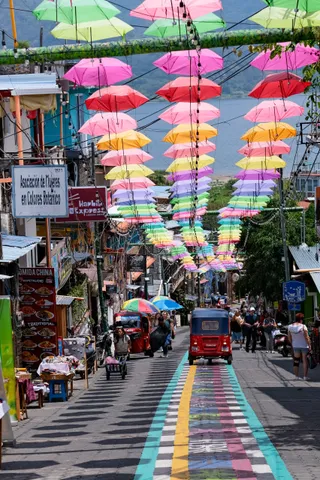
My wife and I visited this town on Lake Atitlán in Guatemala, and going back through our pictures reminds me how much color was packed into the place. Almost every frame has a lot going on: a red tuk-tuk under pastel umbrellas, a painted face surrounded by flowers, patterned fabric hanging from a ceiling.
I also came home with a couple of handmade shirts. With all those textiles around, you can probably see how that happened.
Start by looking up
One street had a veritable kaleidoscope of umbrellas overhead. Underneath, people wander past shopfronts while tuk-tuks squeeze through the narrow street, and the buildings frame a view downhill to the lake and the mountains beyond it. You get plenty to look at before you've walked very far.
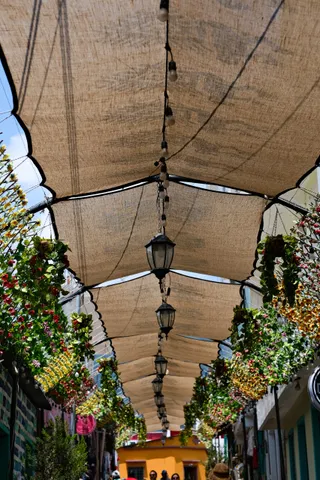
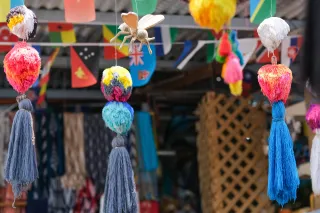
Other stretches feel different. In one lane, fabric shades hang between the buildings with lanterns and flower decorations dangling below them. Another has long purple strips of cloth overhead. The decorations change the light as much as the view.
Our pictures show busy streets, with signs, wires, shoppers, and traffic all crammed into the scene. I like having those details in the photos. They give you a better sense of being there than a perfectly empty street would.
The murals were to die for
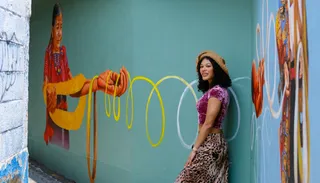
Guatemala has a smorgasbord of murals, and San Juan takes that to another level. There were murals around every corner and tucked away down the alleys, and each one pulled me (and my camera) in for a closer look.
One of our close-ups is almost entirely painted figure, striped fabric, leaves, berries, and white flowers. In another photo, a woman painted against a turquoise background holds yellow thread that loops across the wall.

I brought some of the color home
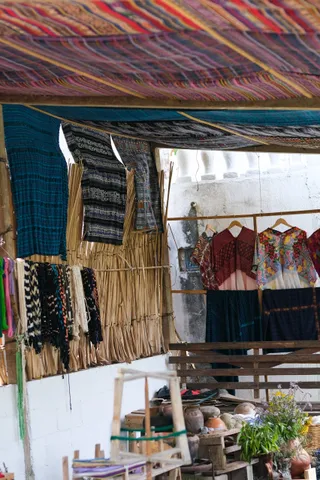
The textiles were the part of the visit that made it into my luggage, in the form of two handmade shirts.
San Juan is home to a Tz’utujil Maya community, and its art and weaving are a big part of why people visit. The town is about 95% Tz’utujil, and according to Wikipedia (opens in a new tab), a local law keeps outsiders from buying land in the municipality. Atitlan Living’s guide (opens in a new tab) has useful background on the town’s artist cooperatives and galleries, which deserve some of your time alongside the obvious street photos.
There's also a lot to learn about how the textiles are made. The local women’s group Casa Flor Ixcaco (opens in a new tab), for example, describes working with organic cotton, natural dyes made from things like leaves and bark, and traditional backstrap looms. That's one group's process, so ask individual sellers about the pieces you're considering.
If you like buying things on your travels, give yourself time here to look closely and ask questions. Who made it? How was it woven? Where did the colors come from? The answers end up being part of what you take home.
Don't forget the lake
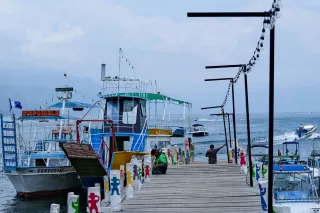
With so much going on in the streets, it's easy to forget the lake is right there. Boats sit beside a wooden dock, and the mountains fade into the haze across the water. There isn't a lot to do down by the water, but it's a relaxing place to take in the view. The lake is also how a lot of people get to San Juan la Laguna. The wife and I took a tuk-tuk from neighboring San Pedro la Laguna.
A few notes for planning a visit
If San Juan la Laguna is on your Lake Atitlán itinerary, I'd leave at least half a day for walking, poking around the shops, and sitting by the water. Give yourself longer if you want to add a workshop or tour.
We took a tuk-tuk from San Pedro la Laguna, and that's the easy way in. Along Dusty Roads’ San Juan guide (opens in a new tab) puts the ride at about 10 minutes and Q15 to Q20 per person (checked October 2026), and tuk-tuks usually wait at San Pedro's main dock. You can also walk it in about 25 minutes; they suggest doing that in daylight when the road is busier. Shared boats connect San Juan with other towns around the lake, such as San Marcos la Laguna. Sort out your ride back once you're there.
The same guide covers the uphill walk to Mirador Kaqasiiwaan, the lookout above town. They list entry to the trailhead at Q30 per person, cash only.
For a fuller itinerary, weaving demonstrations and coffee or cacao experiences are worth looking into. They weren't on our list, so treat them as ideas for your own trip.
And leave a little space in your bag. I needed enough for two shirts.